Coq au Vin
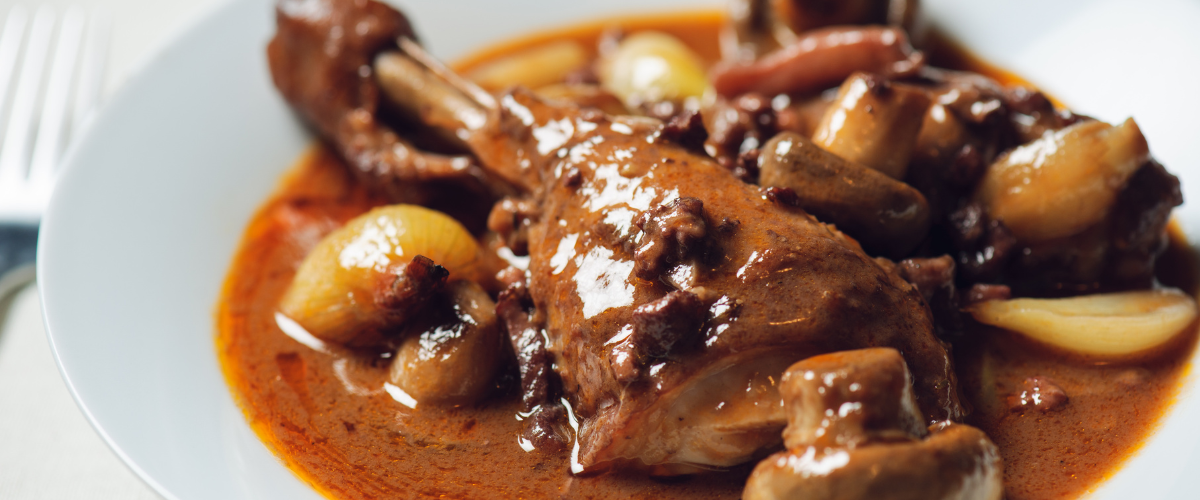
Make-ahead and reasonably easy, this is one of my favourite dinner party meals.
by Erin Henderson
The very first “fancy” recipe I ever cooked was coq au vin.
It wasn’t the first “thing” I ever cooked. I had started cooking in my early 20’s – including an ambitious, vegetarian, Thanksgiving dinner for my sister, boyfriend, and cousin when my parents buggered off on a cruise and left us holiday orphans. But the dishes I had made up until the Dinner of the Coq au Vin, while perhaps zealous for my skill level, were mostly moderate in their results.
After a few years of a few hits and a lot of misses, the time had come for a call up to the big leagues of French chicken stew. This is a standout recipe for me, because, it is, to use a turn of phrase, the recipe that launched a thousand dinners.
You may also like: Classic Boeuf Bourguignon
I was 27, a television news reporter and fill-in anchor for the local arm of a national network, and dating the (then) love of my life. I thought it would be very chic of me to make dinner for my beau and my parents. How grown-up. I was absolutely thrilled at the idea of my first, civilized dinner party. I believe it involved cloth napkins.
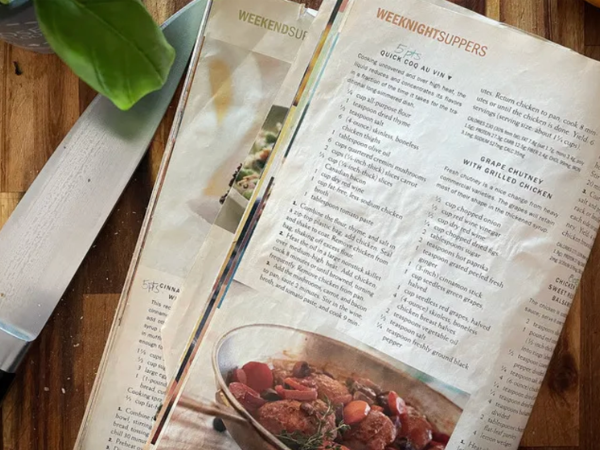
Quick Coq au Vin, the recipe found on page 16 of the circa 2003 specialty publication, The Best of Cooking Light: Simple Suppers, promised I could get six, 230-calorie servings, on the table in 27 minutes.
(I still have that tattered magazine, now naked and frail, the cover having ripped off long ago; the pages loosely held together by ever-weakening staples. The recipes are slightly cringe-worthy in their early aughts fashion of low-calorie and fat-free offerings, but it still holds a place of high respect and reverence for me as the starting point to my serious cooking adventures.)
I remember that quick coq au vin being pretty good. Impressive, even. As a cub home cook, it took me closer to an hour to fumble my way through the kitchen, but still a decent showing. There were linens, there was candlelight. I think we were playing jazz.
Cooking Light’s simple, 11-ingredient coq au vin stayed in my repertoire for years, slowly changing along the way. As my confidence grew, and better ingredients became readily available, the dried thyme the CL recipe called for was swapped out for a bundle of fresh. I almost immediately did away with the prescribed dredging my chicken thighs in flour, instead adding it to the sauce. I also use white wine instead of red, preferring both the taste and the aesthetic, technically making this coq au vin blanc. And when I learned Julia Child fired hers up with a shot of cognac, I did the same (once I figured out what cognac was and got over the sticker shock of the exorbitant pricing. Brandy, incidentally, does just as well.)
Because my life, and my cooking skills, aren’t static, my recipes naturally morph. Sometimes barely noticeable from the original, sometimes the before-and-afters look nothing alike. There are some things I make that are nearly cast in amber – my German mum’s braised red cabbage, our family’s potato salad that everyone loves. But other than a few deeply entrenched family favourites, everything else is up for evolution.
You may also like: Slow Cooker Duck Confit
And so quick coq au vin, has become considerably longer coq au vin, a soothing and rhythmic kitchen project for a grey, Sunday afternoon.
Coq Au Vin
This is a long recipe, but really, quite a straightforward one. If you are someone who panics at the sight of more than 10 ingredients or stops reading upon the discovery that recipes will that take an hour or more, I encourage you to keep going. This is mostly hands off, and the ingredients are humble. In fact, the initial mirepoix of carrot, onion, and celery can be simply scrubbed and roughly chopped, no peeling necessary, as they’re only used to flavour the sauce and discarded later.
Pour a glass of wine, put on some great music, and get lost in the joy of the process. One of the truly great things about coq au vin, is that you don’t necessarily have to prep all the ingredients ahead of time. It takes a few minutes to properly cook the bacon, and then sear the chicken, which means you can prep the next step while the first cooks, so all your time in the kitchen is well-used.
As I learned 25 years ago, this makes a terrific dinner party meal. Once you get the initial prep done, it hits the oven for 45 minutes and you are free to sit with your guests and enjoy a martini or glass of champagne.
Makes: 8 pieces of chicken and about 2 cups of sauce (I estimate 2 pcs and a small ladle-full of sauce per person)
Chef level: moderate
Ingredients:
- 1, 2-3 lb chicken, or 8 pcs of a mix of chicken thighs, drumsticks and breasts, skin-on and bone in
- Salt and pepper
- 6 cups white wine, divided, more if necessary
- 150g pancetta, cubed
- 2 large carrots, roughly chopped
- 3 celery stocks, roughly chopped
- 1 large red onion, quartered
- 5-6 garlic cloves lightly crush and left whole
- Dime-sized cluster of thyme stocks
- 1 Tbsp whole peppercorn
- 5 dried bay leaves
- 2 Tbsp flour
- ½ cup brandy or cognac
- 3 cups white wine
- 2 cups chicken stock, or enough to cover
- 3 Tbsp butter
- 220g button mushrooms, clean, large ones halved
- 300g pearl onions, peeled, large ones halved
- 2 Tbsp sherry vinegar
- ¼ cup sweet sherry (such as Harvey’s Bristol Cream)
- Chives, diced, for garnish
How to Make It:
- Cut your whole chicken into 8 pieces total: wings (2), thighs (2), drumsticks (2), breasts (4) (here’s a really good video showing how to do it – you can leave each breast whole, but I separate each into two.)
- Using a large bowl, submerge your chicken pieces under 3 cups of white wine, using a plate to weigh the meat down, if necessary. Store in the fridge until ready to use, about 6-8 hours.
- Drain and dry the chicken pieces really well and season with salt and pepper on both sides. Discard the wine.
- Set the oven to 350°F.
- In a large stock pot or Dutch oven over medium-low heat, cook the pancetta until well-cooked but not crisp, about 6-8 minutes. Using a perforated spoon, scoop the pancetta out of the pot, drain on paper towels and reserve. Leave the rendered fat in the pot.
- In batches, if necessary, place the chicken skin-side down in the hot fat, allowing to sear and the skin browns, about 7-10 minutes. Flip the chicken over and sear for another 5.
- Set the seared chicken on a rimmed plate or baking tray. (It won't be fully cooked.)
- When all the chicken has seared, add more oil if necessary, and add the carrot, onion, and celery to the pot allowing to cook until slightly coloured, about 6-7 minutes. Watch the heat so the vegetables don’t scorch – adjust if necessary.
- Add the garlic cloves and cook another two to three minutes, stirring occasionally.
- Sprinkle in the flour, stir to coat the vegetables, and cook for another 1-2 minutes.
- Pour in the brandy or cognac and using a wooden spoon scrape up the cooked-on bits from the bottom of the pot for another 2 minutes. This will quickly thicken, and it’s fine if you don’t get everything scraped up.
- Pour in the remaining 3 cups of white wine and continue to stir and get everything scraped up off the bottom.
- Add in the thyme, bay leaf, and peppercorns into the sauce.
- Nestle the chicken pieces, skin side up, on top on the vegetables, pouring in the collected juices from the plate.
- Add the chicken stock, to about ¾ up the chicken, leaving the skin exposed.
- Cover the pot and place in the oven for 45 minutes, until the chicken is cooked through.
- While the chicken is cooking, melt butter in a frying pan over medium heat.
- When melted and frothy, add the pearl onions, cooking for about 2 minutes to lightly brown. Remove from the pan and reserve.
- Add the mushrooms in a single layer and cook undisturbed for about 6 minutes until their liquid is released and evaporated and the mushrooms are brown and slightly crispy. Deglaze the pan with sherry vinegar, being careful of steam, and remove the pan from the heat. Mix the onions back in with the mushrooms and cover to keep warm.
- When time's up, remove the pot from the oven and remove the chicken from the pot, covering chicken with foil to keep warm.
- Strain the sauce in the pot through a fine mesh strainer into a clean, deep sauté pan, pressing on vegetables and solids to drain. Discard solids.
- Bring the sauce to a boil and add in the sweet sherry, mushrooms, and onions.
- Reduce by half, stirring frequently, until running a spoon through the sauce leaves a line on the bottom on the pan that is slow to fill in. About 5 minutes.
- Using rimmed dishes, spread mashed potatoes or cerleriac purée leaving rivets to allow the jus to fill.
- Top the potatoes or purée with two pieces of chicken. Scatter the reserved pancetta over and around the chicken, as well as the onions and mushrooms. Gently pour the sauce over the chicken, being sure to get a few mushrooms and onions on eaach plate. Scatter the reserved pancetta over and around the chicken, as well as the chives and serve.
Wine Pairing
You can (and should!) drink the same wine you used to cook the chicken (though not the wine that marinated the raw chicken – our lawyer asked us to tell you.) A silky Chardonnay from the Mâconnais, or one from Ontario, would be a lovely pairing, matching the creaminess of the saice with the texture of the wine, and complimenting the rich flavours with the orchard fruit and buttery notes of the wine.
As for reds, I'm a big fan (to the surprise of absolutely no one) of Gamay for this dish. The earthy notes in the wine compliment the thyme, peppercorn, and mushroom flavours of the stew, while the bright red fruit bright a bright compliment to coq au vin's deep savoury note.